My client has a chronic genetic condition*. As a child, it caused so much discomfort that she spent weeks confined to her bed at home. During this time, she developed a habit of spending hours searching the internet for interesting facts. She read voraciously about many different subjects, and deeply about very few.
She was the kind of client who needed to chatter for the first third of the massage before she could settle into her body. How could I blame her? Her body had never been a comfortable place to be. She felt safer in her mind. Those 20 or so minutes generally consisted of a wide-ranging array of different facts and stories ranging from the bathing habits of Ancient Romans to genetically modified, drug-testing mice.
One day I will always remember, though, because she spent her entire "talk time" telling me one story. Apparently somewhere in the wild is an orca who has scoliosis. Scientists have been following this whale (and his related pod) for some time. Left alone, this orca would die. His spinal curvature keeps him from hunting effectively, and he does not swim as fast as the other whales. Scientists noted, however, that other whales in the pod were actually helping this orca. They would bring food to him, and if he fell behind, they would sometimes even wait for him to catch up to them. My client had spent much of the night (she didn't sleep well) reading about this whale and watching video footage of the whole pod in action. At first, it was the orca's mother doing all this tending, but then even after his mother died, the rest of the pod continued to take care of him.
My client went over and over this story, each time remembering little details from some video or website or other. Eventually, as in every session, she relaxed into her body and gradually dropped off talking. I had a nagging little sense that something was being opened to me, but I put it aside to focus on her massage.
After she left, I started thinking about the story she told me, and how much it captured her attention. I remembered something a co-worker once said to me: "We use metaphors because they tell us something real." Of course. The story of the orca was a metaphor. Here was this creature with a chronic genetic condition. Left to his own devices, he would have been abandoned and left behind, possibly even left to die. Instead, his fellow creatures stepped in and took care of this creature's needs, thereby keeping him connected to the whole of his world.
My client maybe thought she was telling me the story of an orca, but really, she was telling me the story of her life. Of all the people who stepped in to help and support her when she could have easily been left behind. She told me the story of the orca gave her hope. I suspect it highlighted the hope she already received from those closest to her -- her own pod who kept her connected to the whole of her world.
*-- names and identifying details have been changed
Tuesday, November 29, 2016


Friday, November 25, 2016
Five Words
I know a couple, quite elderly. They have been married for more years than many people get to be alive on this earth. The gentleman has been, until quite recently, very robust for his age. Although he required a small bit of assistance to get into and out of his favorite recliner, he was otherwise very independent. His wife was much more frail. She slept much of the day and rarely ever spoke. When she was awake, she frequently looked at him and smiled, her bright blue eyes twinkling. He would take her hand and raise it to his lips for a kiss, ever the courtly gentleman. He called her "Mama."
Recently, though, he succumbed to various respiratory illnesses, and even though his body was vigorous, it was nearly a century old, so each illness landed him in the hospital for a longer period of time. Each time he came back home, he was a little bit more weak. More devices appeared around him, and the caregivers seemed closer to him for longer periods of time.
Through it all, his wife, still quite frail, looked on him with love, affection, and a growing concern. I knew them only like this, in their increasingly frail old age and decline. I learned a few things about them very quickly, though. Right away I learned that they loved each other with the kind of deep, realistic, daily-work love that is never depicted in poetry. I learned that when they looked at each other, they each saw past their fading physical shells and into a long, shared life of which they were justifiably proud. And I learned that Mama, at least, had gotten everything down to essentials.
Mama rarely spoke. And when she did, she said only “Thank you” or “I love you.” In all the time I was near her, these were the only things I heard her say. I have known for a long time that language is only one of many ways we have to communicate, but her limited vocabulary still struck me, especially since her husband was still so engaged in language and conversation.
One day, however, watching her with her long-term caregiver, it dawned on me that she had things exactly right. Her body was frail, she lacked energy to do more than what was absolutely essential. She had distilled her actions down, and I finally realized, she had also distilled down her language.
As I thought about it, if I could only say five words out loud for the rest of my life, could I think of a better collection than “Thank you” and “I love you”? What other five words would serve to express my connection to the people around me? How much more simple could it be? Every time I visited them, and I saw her saying only “thank you” and “I love you,” I realized how much she had chosen to convey. With her fading strength, knowing every word was an effort, she chose to say the words that kept her connected to all the people around her, and that told them how much she cared for each of them. Could there be another five words more important?
Sunday, July 31, 2016
Maintenance
One of the enduring joys of this job is learning from the person who is going through treatment.
Liesl's* several children all lived out of town, but one of them always drove down for her treatments. All twelve of them. For her birthday, they decided to get together and buy her a massage to go with each of the last four chemo treatments. This is how I had the pleasure of meeting her.
For her last four chemo cycles, Liesl (and whichever son or daughter) arrived at my office the day after her infusion. Each time, Liesl walked herself slowly back to my office with me. She gave me the same list of side effects, each time just a little bit worse than the last. She would lay in a supported, semi-reclined position while I gently held her feet, hands and head. After the massage, she would take my arm for support, walk with me to the waiting room, then give me a hug before she left.
At her last appointment, Liesl asked me to do her a favor. She knew I was connected to some of the staff at her treatment center so she told me, "Please tell them. Tell them they need to touch people." She went on to assure me that she felt she had received good care from caring people, but that it disturbed her that they never seemed to take a minute to just touch their patients. To lay a hand on their arm, or give them a gentle hug. It made her feel cold and somewhat neglected, she said. Cancer treatment was scary enough, she said, without feeling isolated like that. "I have my family there," she said, "but what about the people who don't?"
What she said to me wasn't anything different than what I say to people pretty much all the time, but for some reason it hooked deep into my heart. I wondered, when do I touch people purely for comfort, compassion and to show that they are special to me? Outside of work, when do I do this? And when am I comfortable receiving this kind of touch from my friends and family? This happens a shockingly small amount, if I'm being honest.
I don't have any answers today. I don't have any wisdom. There is just the knowledge, and gratitude to the woman who brought it out for me to look at. There are so many complicated, important things facing the world in general right now -- issues that divide us and might even harm us. From one perspective maybe it seems frivolous for me to spend so much time and brain space worrying about how much we touch each other, and trying to change that.
But then, I ask myself (and you), if you can touch someone with gentleness and true compassion, doesn't that make it harder to objectify, deny or hate them? So, in addition to the staff at the treatment center, I am sending you Liesl's message: with compassion and an open heart, just touch people.

*--name and identifying details have been changed
Liesl's* several children all lived out of town, but one of them always drove down for her treatments. All twelve of them. For her birthday, they decided to get together and buy her a massage to go with each of the last four chemo treatments. This is how I had the pleasure of meeting her.
For her last four chemo cycles, Liesl (and whichever son or daughter) arrived at my office the day after her infusion. Each time, Liesl walked herself slowly back to my office with me. She gave me the same list of side effects, each time just a little bit worse than the last. She would lay in a supported, semi-reclined position while I gently held her feet, hands and head. After the massage, she would take my arm for support, walk with me to the waiting room, then give me a hug before she left.
At her last appointment, Liesl asked me to do her a favor. She knew I was connected to some of the staff at her treatment center so she told me, "Please tell them. Tell them they need to touch people." She went on to assure me that she felt she had received good care from caring people, but that it disturbed her that they never seemed to take a minute to just touch their patients. To lay a hand on their arm, or give them a gentle hug. It made her feel cold and somewhat neglected, she said. Cancer treatment was scary enough, she said, without feeling isolated like that. "I have my family there," she said, "but what about the people who don't?"
What she said to me wasn't anything different than what I say to people pretty much all the time, but for some reason it hooked deep into my heart. I wondered, when do I touch people purely for comfort, compassion and to show that they are special to me? Outside of work, when do I do this? And when am I comfortable receiving this kind of touch from my friends and family? This happens a shockingly small amount, if I'm being honest.
I don't have any answers today. I don't have any wisdom. There is just the knowledge, and gratitude to the woman who brought it out for me to look at. There are so many complicated, important things facing the world in general right now -- issues that divide us and might even harm us. From one perspective maybe it seems frivolous for me to spend so much time and brain space worrying about how much we touch each other, and trying to change that.
But then, I ask myself (and you), if you can touch someone with gentleness and true compassion, doesn't that make it harder to objectify, deny or hate them? So, in addition to the staff at the treatment center, I am sending you Liesl's message: with compassion and an open heart, just touch people.

*--name and identifying details have been changed
Monday, June 20, 2016
How Do I Even Feel About This?
That was the text message I sent to a friend. She does the same kind of work as I do, and I shared my story with her right after it happened, when I was still not sure what to think.
(Warning: there's a semi-graphic description of some nasty treatment side effects following. There is also some cussing. Stop right here if you're easily disturbed by that kind of thing.)
Let me tell you about it. My client has an advanced stage of cancer-*. She has tried many treatments, which have exhausted her body, mind and bank account. She is undergoing a treatment now that causes extremely painful lesions on her skin. The ones I can see look like giant spider bites, but she tells me about others which are open and sometimes weeping. She takes multiple medications to manage her pain. She tells me that as a result she is "much more mellow than usual."
She describes herself as a "hard-driving" person, and talks about raising the money to go abroad for alternative treatment. She says to me: "If I can't afford to go abroad, I don't know what I'll do. Just die, I guess."
That day she wanted me to take a picture of a particularly large lesion on her chest so she could send it to her doctor. She sat on the edge of the table and gingerly pulled away the gauze pad which was covering the wound. I took a couple of quick pictures, then noticed the wound was weeping a bit, so she quickly covered it up and buttoned her shirt.
She wanted to see the pictures before she left. I hand her the smart phone with the last picture on display. She looked at it then started laughing maniacally. "Wow," she said through continuing laughter, "that's really horrible."
And it is. Really horrible. It is also really horrible that despite marijuana, morphine, and massage therapy, she is in constant pain that sometimes takes her breath away. And it's horrible that she may not have access to the treatment she wants because it has been so expensive to keep her alive this long. There is so much horrible here that it is tempting to just drown in it.
But she laughed. She chose to laugh. Not the kind of laugh that makes you wonder if someone is really "all there," but a deeply knowing laugh. The kind of laugh that knows and embraces all that is painful and dark about her human experience. It was a "Fuck you, I will go on" laugh.
And, I will admit it, I found it disturbing at first. Then I didn't know what to think, so I texted my friend and colleague. Her response was perfect: "I love this while my heart breaks."
I love this. My heart breaks. This is the circle I step into, as soon as I leave work for the day. Fortunately, love and breath and understanding friends win out, and I am ready every day to come back.
*- name and identifying details have been changed

(Warning: there's a semi-graphic description of some nasty treatment side effects following. There is also some cussing. Stop right here if you're easily disturbed by that kind of thing.)
Let me tell you about it. My client has an advanced stage of cancer-*. She has tried many treatments, which have exhausted her body, mind and bank account. She is undergoing a treatment now that causes extremely painful lesions on her skin. The ones I can see look like giant spider bites, but she tells me about others which are open and sometimes weeping. She takes multiple medications to manage her pain. She tells me that as a result she is "much more mellow than usual."
She describes herself as a "hard-driving" person, and talks about raising the money to go abroad for alternative treatment. She says to me: "If I can't afford to go abroad, I don't know what I'll do. Just die, I guess."
That day she wanted me to take a picture of a particularly large lesion on her chest so she could send it to her doctor. She sat on the edge of the table and gingerly pulled away the gauze pad which was covering the wound. I took a couple of quick pictures, then noticed the wound was weeping a bit, so she quickly covered it up and buttoned her shirt.
She wanted to see the pictures before she left. I hand her the smart phone with the last picture on display. She looked at it then started laughing maniacally. "Wow," she said through continuing laughter, "that's really horrible."
And it is. Really horrible. It is also really horrible that despite marijuana, morphine, and massage therapy, she is in constant pain that sometimes takes her breath away. And it's horrible that she may not have access to the treatment she wants because it has been so expensive to keep her alive this long. There is so much horrible here that it is tempting to just drown in it.
But she laughed. She chose to laugh. Not the kind of laugh that makes you wonder if someone is really "all there," but a deeply knowing laugh. The kind of laugh that knows and embraces all that is painful and dark about her human experience. It was a "Fuck you, I will go on" laugh.
And, I will admit it, I found it disturbing at first. Then I didn't know what to think, so I texted my friend and colleague. Her response was perfect: "I love this while my heart breaks."
I love this. My heart breaks. This is the circle I step into, as soon as I leave work for the day. Fortunately, love and breath and understanding friends win out, and I am ready every day to come back.
*- name and identifying details have been changed

Monday, April 25, 2016
Revolutionary Radicalness! Radial Revolutionaries!
I just got back from the Society for Oncology Massage's Healing Summit in Minnesota. It was three action-packed days of learning and connecting. I am slowly sorting through all the information and ideas. I will be doing that for some time now.
The first thing to come forward in my mind, asking for my attention, is our inclination to put what we do in the superlative. I attended a session describing new approaches to a task we all do as "radical." While I'm pretty sure the (very good) presenters were a bit tongue-in-cheek when they chose that word, it did make me realize how much we do the same thing without thinking about it. We talk about our "amazing" results, our "unbelievable" experiences, and our "top-notch" skills.
Maybe these words are appropriate. I have often felt that language fails me when I try to describe a session. And I love this work. (Love! The superlative emotion!) I am committed to go to work every day, through budding fatigue and surrounding life stresses, because the work engages and energizes my mind and heart. But does that mean I need to shout about it?
Why not choose, instead, quiet conversations with colleagues, storytelling (in person or maybe, I don't know, on a blog), and a moment every day to sit alone in gratitude for the day? Maybe it's the introvert in me, but this feels better. We can be (and often are) excellent. We can serve our clients and our colleagues without shouting to each other about our total awesomeness.
At the end of a session with one of my frail clients today, my feedback was a warm smile, lingering handshake, and a direct gaze into my eyes with a faintly whispered, "Thank you." One barely audible moment that showed me that my client felt better after the session than he did before. Why should I ask for or expect anything more? Truthfully, why should I ask for or expect anything, if I am truly trying to serve my clients and not my ego?
Now that I am home, I am resolved to speak more gently about my work. I can express the depth of my commitment to this profession without shouting about it. I am resolved to remember this quote from Susan Cain's book Quiet:

The first thing to come forward in my mind, asking for my attention, is our inclination to put what we do in the superlative. I attended a session describing new approaches to a task we all do as "radical." While I'm pretty sure the (very good) presenters were a bit tongue-in-cheek when they chose that word, it did make me realize how much we do the same thing without thinking about it. We talk about our "amazing" results, our "unbelievable" experiences, and our "top-notch" skills.
Maybe these words are appropriate. I have often felt that language fails me when I try to describe a session. And I love this work. (Love! The superlative emotion!) I am committed to go to work every day, through budding fatigue and surrounding life stresses, because the work engages and energizes my mind and heart. But does that mean I need to shout about it?
Why not choose, instead, quiet conversations with colleagues, storytelling (in person or maybe, I don't know, on a blog), and a moment every day to sit alone in gratitude for the day? Maybe it's the introvert in me, but this feels better. We can be (and often are) excellent. We can serve our clients and our colleagues without shouting to each other about our total awesomeness.
At the end of a session with one of my frail clients today, my feedback was a warm smile, lingering handshake, and a direct gaze into my eyes with a faintly whispered, "Thank you." One barely audible moment that showed me that my client felt better after the session than he did before. Why should I ask for or expect anything more? Truthfully, why should I ask for or expect anything, if I am truly trying to serve my clients and not my ego?
Now that I am home, I am resolved to speak more gently about my work. I can express the depth of my commitment to this profession without shouting about it. I am resolved to remember this quote from Susan Cain's book Quiet:
"There's zero correlation between being the best talker and having the best ideas."

Monday, March 21, 2016
No Ego No Cry
I arrived early to find my client seated in his living room.* "Come in, Rebecca," he said, "Sit down. I need to talk to you." The way he said it made it clear that he was not about to compliment my amazing promptness.
He asked me what it was that I was doing the last few times I had been there. What kind of work did I call that? It was an honest, direct question. I gave him my stock line about Western, anatomy-based massage adapted to reduce any additional strain on his body. He nodded to show me that he understood. Then he described his last massage therapist. Her strong hands. How the work was so much more beneficial for him. He wondered if this was something I could do, and if not, would it be worth it to either of us for me to keep coming back again?
I swallowed my tirade about gentle work and my knowledge of the physiological changes happening in his body. I swallowed the urge to tell him I knew how to work with his body better than his previous therapist, that he was somehow wrong for getting more benefit from her work than mine.
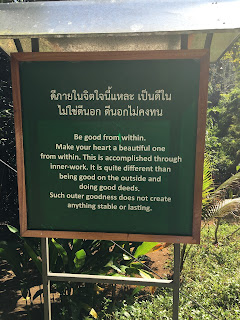
Instead, I remembered the mantra I used when I was learning in Thailand: no ego, no cry.
I asked him more about his previous treatments, if he could describe what he found particularly beneficial. I listened to him talk about the skill of his previous therapist. I nodded to show I understood. The massage I gave him that day was more muscle-adhesion focused, still within the boundaries of my training and comfort level.
He invited me to talk to him about what I was doing so he could understand. I inhaled and exhaled -- reminded myself that this was not a person trying to trip me up in a mistake so he had an excuse to fire me. This was a person who truly sought to understand my approach to his body. I explained what I could, answered his questions as clearly as I could. I did all of this until he began to breath more deeply, and settled into his massage.
That day I discovered my next Why. Why I am not done with massage. My ego was my biggest struggle in Thailand, and that struggle came home with me. In fact, it was started here. My next challenge to to find out how to end it. Here.
* -- identifying details have been changed
He asked me what it was that I was doing the last few times I had been there. What kind of work did I call that? It was an honest, direct question. I gave him my stock line about Western, anatomy-based massage adapted to reduce any additional strain on his body. He nodded to show me that he understood. Then he described his last massage therapist. Her strong hands. How the work was so much more beneficial for him. He wondered if this was something I could do, and if not, would it be worth it to either of us for me to keep coming back again?
I swallowed my tirade about gentle work and my knowledge of the physiological changes happening in his body. I swallowed the urge to tell him I knew how to work with his body better than his previous therapist, that he was somehow wrong for getting more benefit from her work than mine.
Instead, I remembered the mantra I used when I was learning in Thailand: no ego, no cry.
I asked him more about his previous treatments, if he could describe what he found particularly beneficial. I listened to him talk about the skill of his previous therapist. I nodded to show I understood. The massage I gave him that day was more muscle-adhesion focused, still within the boundaries of my training and comfort level.
He invited me to talk to him about what I was doing so he could understand. I inhaled and exhaled -- reminded myself that this was not a person trying to trip me up in a mistake so he had an excuse to fire me. This was a person who truly sought to understand my approach to his body. I explained what I could, answered his questions as clearly as I could. I did all of this until he began to breath more deeply, and settled into his massage.
That day I discovered my next Why. Why I am not done with massage. My ego was my biggest struggle in Thailand, and that struggle came home with me. In fact, it was started here. My next challenge to to find out how to end it. Here.

* -- identifying details have been changed
Wednesday, March 9, 2016
Today is Why
You may recall that Beatrice helped me realize that I need to stick with this profession. Since then, I have been struggling with the question of why.
Today is why.
I had 3 clients today, all with a cancer diagnosis in the same organ of their bodies. You could guess the progression and prognosis of their treatment by the hair on their heads -- from bald, to pixie fringe, to long, heavy ponytail. You could tell a little about their comfort with their bodies by their unguarded eyes -- and be careful not to assume the eyes match the disease progression. The most raw fear peeks out from under that long, heavy ponytail.
The expectations we set together have been simple, realistic, and sometimes elusive. "Give me that glowy feeling I always get from massage." "Help me relax so I can sleep tonight." "Just make my legs feel more comfortable." My past tendency was to say 'Yes. I will do that," then spend the better part of the session worrying about whether or not I was doing that.
Today I tried something new. Instead of "I will do that," I started with "I will hold that intention." Instead of worrying about keeping my promise, I found myself present in breathing and being with the person in the room. Out of that beginning, I found myself more able to feel and interpret what was under my hands, and feeling much more energetic at the end of the day.
I needed to learn and feel that again. This is why I need to stick with this profession. Or at least one of many "why"s. It is my intention to keep open and aware for the next ones.

Today is why.
I had 3 clients today, all with a cancer diagnosis in the same organ of their bodies. You could guess the progression and prognosis of their treatment by the hair on their heads -- from bald, to pixie fringe, to long, heavy ponytail. You could tell a little about their comfort with their bodies by their unguarded eyes -- and be careful not to assume the eyes match the disease progression. The most raw fear peeks out from under that long, heavy ponytail.
The expectations we set together have been simple, realistic, and sometimes elusive. "Give me that glowy feeling I always get from massage." "Help me relax so I can sleep tonight." "Just make my legs feel more comfortable." My past tendency was to say 'Yes. I will do that," then spend the better part of the session worrying about whether or not I was doing that.
Today I tried something new. Instead of "I will do that," I started with "I will hold that intention." Instead of worrying about keeping my promise, I found myself present in breathing and being with the person in the room. Out of that beginning, I found myself more able to feel and interpret what was under my hands, and feeling much more energetic at the end of the day.
I needed to learn and feel that again. This is why I need to stick with this profession. Or at least one of many "why"s. It is my intention to keep open and aware for the next ones.
Subscribe to:
Posts (Atom)